

The best way to memorize lines is to understand what your character wants in each moment, then practice producing the lines from memory instead of rereading them. Learn your cues with your lines, work through one short section at a time, and say everything out loud. Rereading the script feels productive, but it mostly teaches you to recognize the words. Recalling them is what lets you say them when your cue comes.
Read the whole script first
Before you learn a single line, read the full play or screenplay, not just your scenes. You need to know what happens, who your character is talking to and what they want from each person. A line is much easier to remember when you know why your character says it.
Research backs this up. Helga and Tony Noice spent years studying how actors learn their parts, and in a 2006 review they report that professional actors rarely learn roles by rote. In one of their studies, students who went through a passage while imagining they were explaining its meaning to someone remembered more of it than students who simply tried to memorize it. When you learn lines for a play, the meaning comes first and the words follow.
Break your part into beats
A beat is a short stretch of a scene where your character wants one thing. When the want changes, a new beat starts. Mark the beats in your script with a line in pencil and give each one a few words: "asks for help", "gets angry", "changes the subject".
Beats are better units than pages or lines. Each one has a clear purpose, so the words in it hang together, and the list of beats is a map of the scene. If you lose a line on stage, you still know which beat you are in and where the scene is going.
Learn your cues along with your lines
A cue is the line or action that comes right before you speak. Knowing your own words is only half the job: you also need to know exactly when to say them. This is what makes learning a script different from memorizing a speech, where no one else's words tell you when to start.
When you practice, always say the last few words of the cue first, then your line. If you are learning alone, read the cue to yourself or write it above your line, then cover your line and say it. Over time the cue becomes the trigger, so hearing it on stage brings your line with it.
Learn one beat at a time
Don't try to learn a whole scene in one go. Learn the first beat until you can say it, then add the second and say both, then add the third and go back to the start.
Going back to the beginning each time means the opening of the scene gets the most practice, and each beat is linked to the one before it. The scene starts to run as one piece instead of separate chunks you have to jump between.
Recall your lines instead of rereading them
This step makes the biggest difference. In a 2006 study by Roediger and Karpicke, students who practiced recalling a passage remembered more of it a week later than students who spent the same time rereading it, even though the rereaders felt more confident. Recall feels harder, and that effort is why it works. Learning this way is called active recall, and our guide to the steps for active recall shows how to use it on any text.
A few ways to practice recall with a script:
- Cover and say. Cover your line with a card, read the cue, say your line, then uncover it and check.
- First letters. Write only the first letter of each word ("T b, o n t b" for "To be, or not to be") and speak from that. It gives you just enough of a hint.
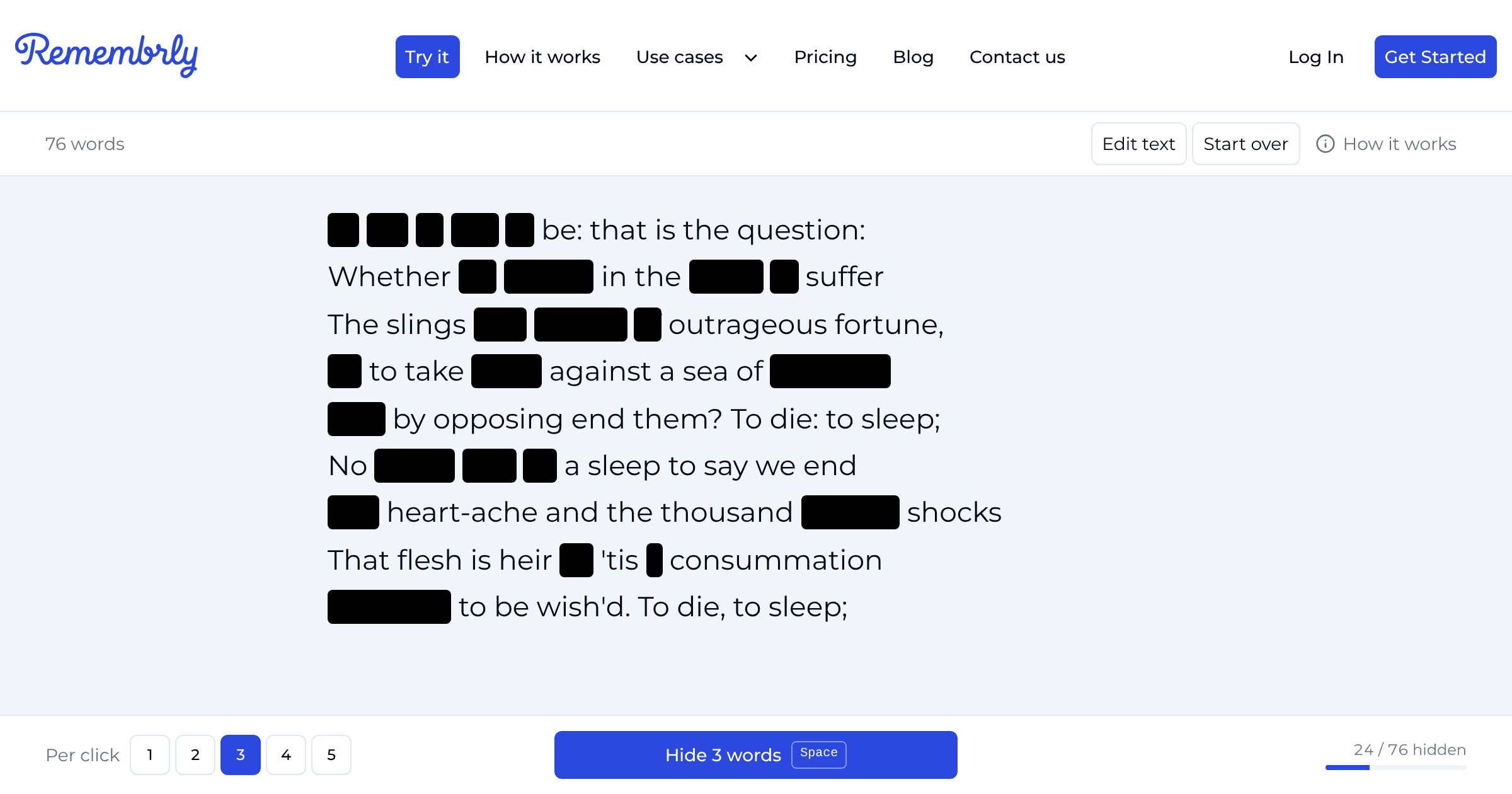
- Fading words. Hide a few words, say the line, then hide a few more each round until nothing is left.
Fading words sits between rereading and a blank page. You still see most of the text, but every gap is a word you have to pull from memory, and the gaps grow each round. Memory researchers call this the method of vanishing cues; in a 1986 study it helped people with memory problems learn new computer terms.
It's the method I built Remembrly around. I made the first version in a couple of days for my grandma, who loves learning her favorite poems by heart. She still uses it: each time she reads a poem through, about five more words disappear, and she keeps going until she can say it with the screen blank. Lines work the same way. Paste a scene into the line memorizer with the cue words included, read it once, and fill the gaps from memory as the words fade.
Say them out loud and move
Lines learned silently often fall apart the first time you speak them. Your mouth needs practice with the words, and you need to hear the rhythm of each line. Practice at the volume you will use, standing up.
Movement helps too. In the Noices' research, actors remembered lines they had spoken while moving better than lines spoken without movement, even when they didn't repeat the movement at the test. If you know your blocking, walk it while you practice. If you don't, pick simple moves that fit the line: cross the room, sit down, pick something up.
Spread practice over days and sleep on it
Several short sessions over a few days work better than one long session the night before. A break means you have to work a little to bring the lines back at the start of each session, and that effort is what makes them stick.
Sleep matters as well. In a 2006 study by Gais, Lucas and Born, high school students remembered vocabulary better when they slept within a few hours of learning it than when many hours of being awake came first. A last round of lines in the evening, then a full night's sleep, is a good habit. In the morning, run the lines once before you look at the script.
Run your lines off book, then with a partner
You are off book when you can say every line of the scene, with its cues, and nothing in front of you. Do that at least twice on different days before the first off-book rehearsal.
Then run the scene with someone. A friend reading the other parts, or a recording of the other characters' lines with gaps for yours, adds the pressure of real timing. Ask your partner to read the cues flatly at first, then with different energy, so you learn to respond to the cue and not to one way of saying it.
How long does it take to memorize lines?
It depends on how many lines you have, how complex the language is and how much time you give it each day. As a rough guide:
- A one-minute audition monologue: two or three short sessions over a day or two.
- A few scenes in a play: about a week of short daily practice.
- A lead role: several weeks. Start as soon as you are cast, and aim to be off book by the date your director sets.
Verse and older language, like Shakespeare, usually takes longer than modern dialogue. Start earlier than you think you need to. To get used to verse first, try Shakespeare's Sonnet 18: 14 lines, where the rhymes help you keep the order.
How to memorize lines fast
If you have a script to learn by tomorrow, don't try to perfect every word at once.
- Read the scenes once for meaning, so you know what each moment is about.
- Mark the beats and learn them in order, building from the start.
- Practice each beat by recall, out loud, in short rounds with breaks of a few minutes.
- Spend extra time on your first line and on the cues for each entrance.
- Do a last round before bed and get a full night's sleep.
- In the morning, run the whole thing once from memory before you go.
The same steps work for how to memorize a script fast for a self-tape or a reading. Bring the script, even if you don't plan to look at it.
Start with your first scene
Pick the first scene you are in and learn the opening beat now. Paste it into Remembrly with your cues, read it once, and let the words fade until you can say your lines from memory. If the scene is longer than 250 words, start with the first beat and add the rest in parts.