

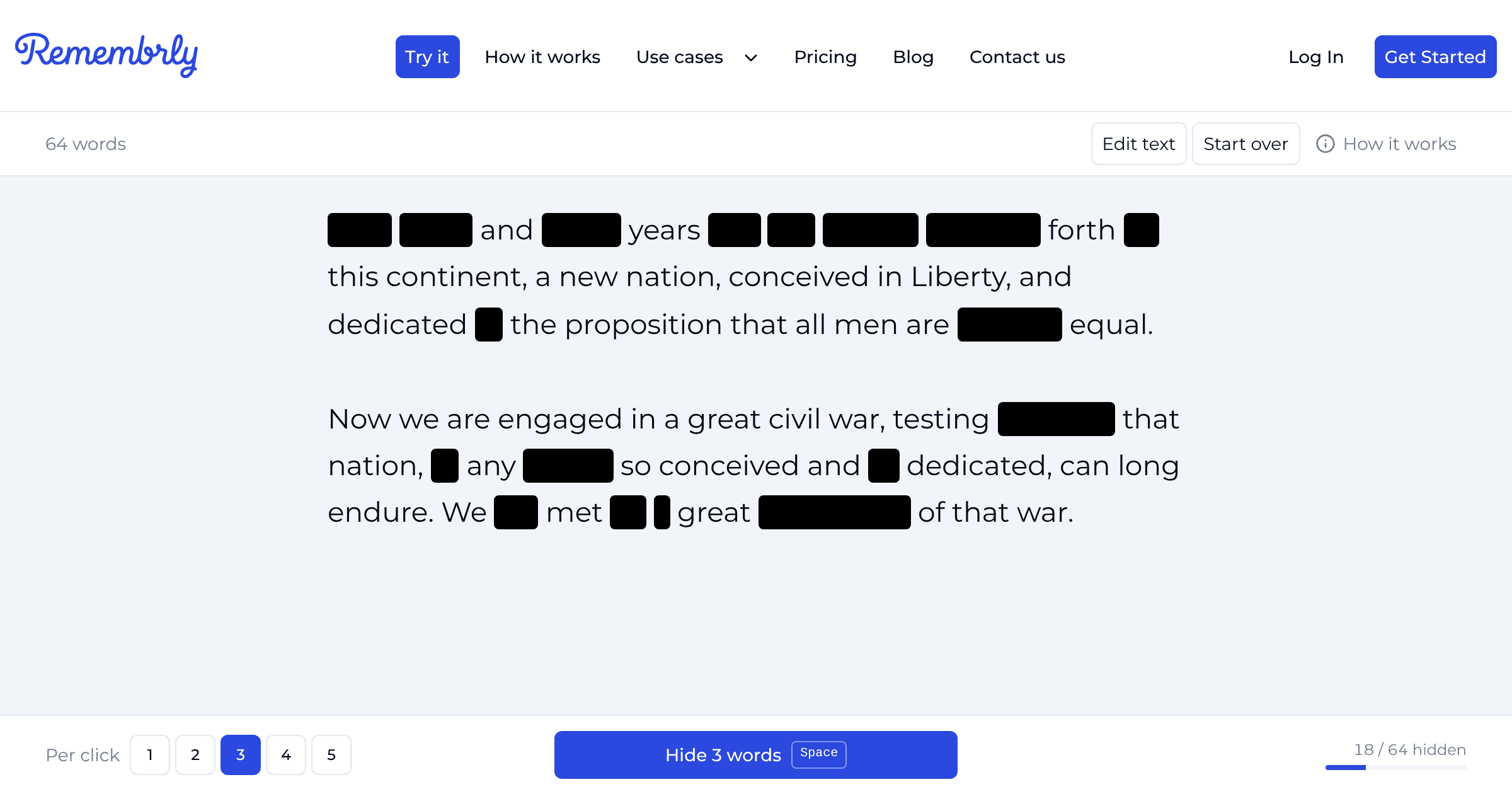
The best way to memorize a speech is to stop rereading it and start recalling it. Read it a few times to understand it, then make yourself produce the words: say it with the text covered, or with more and more words missing, and check only when you get stuck. Rereading the full text feels productive, but it mostly teaches you to recognize the words. Filling a gap from memory is what teaches you to say them.
Decide what to memorize word for word
Not every speech needs to be memorized word for word. Short speeches with no notes, like a wedding toast, a eulogy or a school speech, usually work best memorized exactly, because you always know what comes next and you don't have to find words under pressure.
For a long talk or presentation, memorize three parts word for word: the opening, the closing and the line that takes you from one section to the next. Know the middle of each section as a set of points you can say in your own words. That way the parts where people tend to freeze, the first minute and the moves between sections, are fixed, and the rest sounds natural.
Write it the way you speak
A speech written like an essay is hard to memorize, because you would never say those sentences out loud. Before you start learning it:
- Read it aloud and change every sentence you stumble over.
- Keep sentences short. One idea per sentence is easier to remember and easier to follow.
- Use your own words. If a phrase isn't something you would say, you will keep forgetting it.
- Repeat key phrases on purpose. Repetition helps the audience, and it gives you anchors.
This step also makes the speech better. Most of what is hard to memorize is also hard to listen to.
Learn the structure before the words
Split the speech into 3 to 6 sections and give each one a single word or short phrase: "story", "problem", "three reasons", "thank you". Learn that list in order until you can say it without thinking.
The outline is your map. If you lose a sentence on the day, you still know which section you are in and what comes next, so you can skip ahead instead of stopping. It is also what you would write on a card if you are allowed notes.
Memorize it in chunks
Don't try to learn the whole speech at once. Learn the first section until you can say it, then add the second and say both, then add the third and start again from the top.
Starting from the beginning each time means the opening gets the most practice, which is where nerves hit hardest. It also links each section to the one before it, so the speech runs as one piece instead of separate parts you have to jump between.
Recall it, don't reread it
This is the step that makes the biggest difference. In a 2006 study by Roediger and Karpicke, students who practiced recalling a text remembered more of it a week later than students who spent the same time rereading it. Recall is harder, which is exactly why it works. For the research behind it, see what active recall is; for the steps with each kind of material, see our guide on how to do active recall.
A few ways to practice recall:
- Cover and say. Read a paragraph, cover it, say it, then check what you missed.
- First letters. Write only the first letter of each word ("F s a s" for "Four score and seven") and speak from that. It gives you just enough of a hint.
- Fading words. Hide a few words, say the paragraph, then hide a few more each round until nothing is left.
Fading words sits between rereading and a blank page. You still see most of the text, but every gap is a word you have to pull from memory, and the gaps grow each round until nothing is left. Memory researchers call this the method of vanishing cues; in a 1986 study it helped people with memory problems learn new computer terms.
It's the method I built Remembrly around. I made the first version in a couple of days for my grandma, who loves learning her favorite poems by heart. She still uses it: each time she reads a poem through, five more words disappear, and she keeps going until she can say it with the screen blank. A speech works the same way. Paste it into the speech memorizer, read it once, and fill the gaps from memory as the words fade. It's free for up to 250 words per session, which is about two minutes of speaking.
Practice out loud, on your feet
Saying a speech in your head is not the same as saying it out loud. Your mouth needs practice with the words, and you need to hear how long the pauses are. Practice standing up, at the volume you will use, and if you can, in a room like the one you will speak in.
Time yourself too. Most people speak at roughly 130 to 150 words a minute, so a 400-word toast takes about three minutes. If you run long, cut words now rather than rushing on the day.
Recording yourself on your phone and listening back while you walk or commute is a useful extra, but treat it as review. It doesn't replace saying the speech yourself.
Spread practice over days and sleep on it
Four 15-minute sessions over two days work better than one hour the night before. A break between sessions means you have to work a little to recall the speech at the start of each one, and that effort is what makes it stick. Sleep also helps your brain hold on to what you practiced that day.
A simple schedule for a short speech:
- Day 1: fix the wording, learn the outline, then learn the speech in chunks.
- Day 2: two or three full runs from memory, checking the text only when you get stuck.
- Day 3 and after: one or two runs a day with no text at all, out loud and timed.
Rehearse from a blank page, then in front of someone
You are ready when you can give the whole speech, out loud, with nothing in front of you. Do that at least twice on different days.
Then say it to one person, or to a camera if no one is around. Speaking to a listener adds a bit of pressure, and finding your weak spots at home is much better than finding them on stage.
How long does it take to memorize a speech?
It depends on the length of the speech and how much of it needs to be word for word. As a rough guide:
- A one- or two-minute toast: two or three short sessions over a day or two.
- A five-minute speech: about a week of short daily practice.
- A 15- to 20-minute talk: memorize the opening, the closing and the transitions word for word, learn the rest as points, and start at least two weeks ahead.
Start earlier than you think you need to. The last few runs, when the speech starts to feel easy, are the ones that keep you calm on the day.
How to memorize a speech in one night
If you only have tonight, don't try to learn every word.
- Learn the outline first, so you can always find your place.
- Memorize the opening and the closing word for word.
- Learn the middle as key points and say them in your own words.
- Do three or four rounds of recall out loud with short breaks, not one long session.
- Go to bed on time. Sleep after practice helps the speech stick.
- In the morning, do one full run from memory before you go.
Bring the outline on a card, even if you don't plan to look at it.
What to do if you go blank
Even a well-learned speech can disappear for a moment. If it happens:
- Pause and breathe. A few seconds of silence feels much longer to you than to the audience.
- Go to the next keyword in your outline and carry on from there. Nobody knows what you skipped.
- Repeat your last sentence. It often brings the next one back.
Start with your speech
Pick the opening of your speech and practice it now. Paste it into Remembrly, read it once, and let the words fade until you can say it from memory. If your speech is longer than 250 words, start with the opening and add the rest in parts.