

Active recall is a way of learning where you pull information out of your memory instead of looking at it again. You try to remember first, then check. It matters because the effort of remembering is what makes things stick: a test you give yourself teaches you more than another pass over your notes.
How active recall works
Every time you learn something, you do two things: you put it into memory, and later you take it back out. Most studying focuses on the first part. You read, highlight and reread, and the material goes in again and again.
Active recall focuses on the second part. You close the book and ask yourself a question: what were the three causes, what is the next line, what does this word mean. Then you try to answer it with nothing in front of you, and only then open the book to check.
A simple example: rereading a page about the water cycle is passive review. Closing the book and explaining the water cycle from memory, then checking what you left out, is active recall. Same material, same 10 minutes, a very different result.
Researchers call this retrieval practice, and the benefit it brings the testing effect. The test doesn't have to be graded or even written down. What counts is that you produce the answer yourself.
Why active recall works
The best-known study on it is a 2006 experiment by Roediger and Karpicke. College students read short passages about the sun and about sea otters. After the first reading, they either read the passage again or wrote down everything they could remember from it, with no feedback.
Five minutes later, the students who had reread the passage remembered a little more: 81% of the ideas against 75%. A week later the result flipped. The students who had practiced recall remembered 56% of the ideas, and the students who had reread remembered 42%. Rereading helps you for the next few minutes. Recall is what lasts.
Other work points the same way. A 2013 review led by John Dunlosky rated 10 common study techniques. Practice testing, which is active recall, was one of only two that got the highest rating. Rereading, highlighting and summarizing were rated low.
Recall even helps when you get the answer wrong. In a 2009 study by Kornell, Hays and Bjork, people who tried and failed to answer a question before seeing the answer learned it better than people who simply read the question and answer together. The attempt itself prepares your memory for the answer.
Why active recall feels harder than rereading
Rereading feels good. The text looks familiar, the sentences flow, and you get a sense that you know it. But recognizing words on a page is a different skill from producing them without the page, and only the second one helps you in an exam, on a stage or in a conversation.
The Roediger and Karpicke study shows how misleading that feeling is. In their second experiment, students who read a passage four times were the most confident they would remember it a week later. They remembered the least: 40% of the ideas, against 61% for students who read it once and then practiced recall three times.
Active recall feels harder because it is harder. You notice every gap, and that can feel like failing. It isn't. A gap you notice while practicing is one you can fix before it matters.
Active recall vs passive review
Most study habits have an active recall version that takes the same time.
| Passive review | Active recall version |
|---|---|
| Rereading your notes | Closing them and writing what you remember |
| Highlighting a chapter | Turning each heading into a question and answering it |
| Reading the answers to practice questions | Answering them first, then checking |
| Reading a poem over and over | Saying it with more and more words missing |
| Watching a lecture again | Explaining its main points out loud from memory |
Reading still has a place. You need to read the material once to understand it, and you need to check your answers against it. The change is what you do with the rest of your time: produce the answers instead of reviewing them.
Examples of active recall studying
Active recall looks different depending on what you are learning:
- Vocabulary and definitions. Flashcards: the word on one side, the meaning on the other. Say the answer before you flip the card.
- A textbook chapter. Write down everything you remember on a blank page, then compare it with the chapter. This is often called blurting.
- A subject with problems to solve. Do practice questions or past papers before you look at the worked answers.
- An idea you need to understand. Explain it out loud as if to a friend who has never heard of it. The places where you stall are the places to review.
- A text you need word for word. Cover a paragraph and say it, then check. Or write only the first letter of each word and speak from those. For a talk you have to give, our guide on how to memorize a speech puts these steps together.
The common thread: the answer comes from you first, and the source is only for checking.
Fading words: active recall for text you need word for word
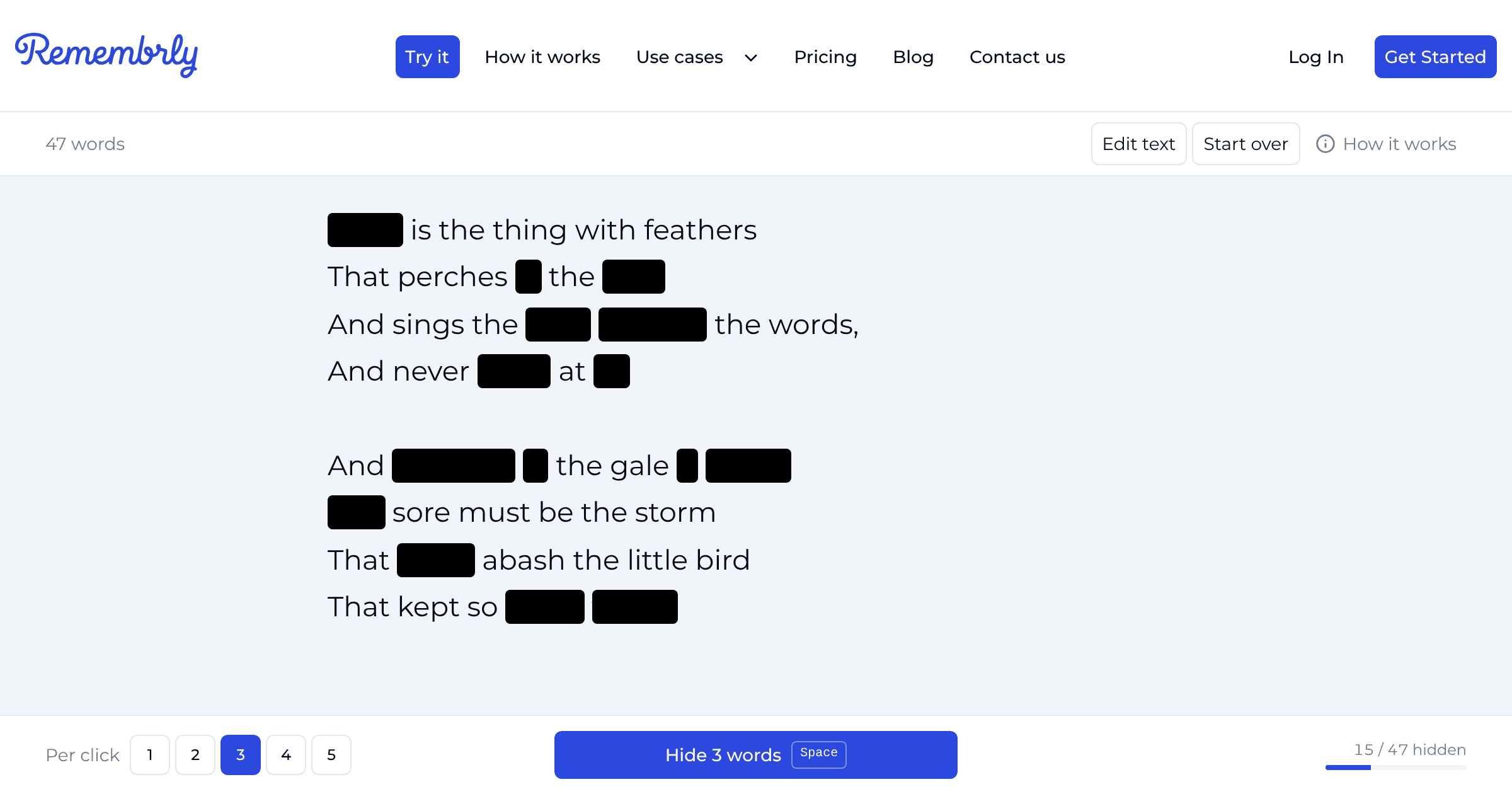
For a poem, a speech, a verse or a script, flashcards break the text into pieces, and a blank page is a big jump on the first day. Fading words sits in between. You read the text, a few words disappear, and you say it through with the gaps filled in from memory. Then a few more words go, and you go again, until nothing is left on the screen.
It counts as active recall because every gap is a word you have to pull from memory, and the gaps grow each round. Memory researchers call this the method of vanishing cues. In a 1986 study it helped people with memory problems learn new computer terms.
It's the method I built Remembrly around. I made the first version in a couple of days for my grandma, who loves learning her favorite poems by heart. She still uses it: each time she reads a poem through, about five more words disappear, and she keeps going until she can say it with the screen blank. That last run, with nothing in front of her, is active recall in its purest form.
Common active recall mistakes
- Peeking too soon. If you check the answer before you have really tried, you are recognizing it, not recalling it. Give yourself a few seconds of effort first.
- Testing only what you already know. It feels good to get everything right, but the cards and sections you keep missing are the ones that need the practice.
- Not checking your answers. Recall without checking can lock in a mistake. Always compare what you produced with the source.
- Doing it once. One round of recall helps, but a few short rounds spread over several days help much more. Come back to the material the next day and start from memory.
- Waiting until you feel ready. You don't need to know the material before you test yourself. The testing is how you get to know it.
How to start with the active recall method
Pick one thing you are learning this week and replace one rereading session with recall. For notes, write what you remember on a blank page. For a list of terms, make 10 flashcards. For a text you need word for word, let the words fade and fill the gaps.
For a full walkthrough, with the steps for each kind of material and a comparison of the methods, see our guide on how to do active recall.
Try active recall on one text today
Choose a short text you want to know by heart: a poem, the opening of a speech, a verse, a quote. Paste your text into Remembrly, read it once, and let the words fade until you can say the whole thing from memory. It's free for up to 250 words per session, with no sign-up. If you'd rather start with a text that's ready, Psalm 23 (118 words) and the Lord's Prayer (56 words) open with nothing to paste.